Category Archives: Codes2Share

I share my codes, simple but effective.

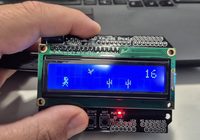
The Project: Dino Runner on 16×2 Character LCD
By | September 30, 2026

We often buy developer kits with grandiose industrial ambitions, only to leave half the shields sitting in parts drawers gathering dust. Recently, while clearing off my workbench, I grabbed an Elegoo Uno R3 clone paired with a ubiquitous 16×2 LCD keypad shield. The original plan was a quick telemetry display, but old gaming instincts took… Read More: The Project: Dino Runner on 16×2 Character LCD »
Using SimurgArray, and the bird behind the name

By | September 30, 2026

Part 5 of 5. Four posts of reasons are enough. This one is about what it looks like when you actually use the thing, and about the name, which people ask about more often than they ask about normalization. Fair enough. One small note first. The command examples below use the usual command line options,… Read More: Using SimurgArray, and the bird behind the name »

rarelens: building a rare-disease variant triage platform, and the four things I got wrong

By | September 12, 2026

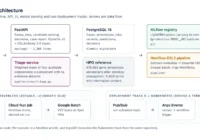
An end-to-end rare-disease variant triage platform: a Nextflow pipeline, three execution backends behind one API call, Terraform for two cloud tracks, and a phenotype-driven ranking measured against 10,178 published cases. Including the model metric that collapsed to exactly random once I removed the feature doing all the work.

Beyond the 2D Bounding Box: Why Bioimage Deep Learning Is a Completely Different Beast and How BiaPy Tames It

By | August 24, 2026

https://github.com/lynchaos/biapy-hub https://lynchaos-biapy-hub-app-hlcmfj.streamlit.app/ If you have spent your machine learning career optimizing ResNets or YOLO on ImageNet and COCO, here is an inconvenient truth: standard computer vision has spoiled you. In standard computer vision, a batch is usually an RGB triplet where . The pixels are isotropic, the spatial coordinates are Euclidean, the lighting is roughly… Read More: Beyond the 2D Bounding Box: Why Bioimage Deep Learning Is… »

I turned a Raspberry Pi into a tiny weather intelligence powerhouse

By | August 16, 2026

A Raspberry Pi Zero 2 W paired with a Sense HAT V2 runs a fully self-contained, edge-native machine learning weather station with no cloud, GPU, or heavy ML frameworks. The system uses pure NumPy implementations of Recursive Least Squares, Kalman filtering, conformal prediction, and drift detection, staying under 150 MB RAM. The station continuously updates… Read More: I turned a Raspberry Pi into a tiny weather intelligence… »

Building a fake microscope: simulating a yeast wet mount

By | August 1, 2026

Repository: github.com/lynchaos/generative-microscopy Why this sketch I wanted to find out whether I could make something that genuinely looked like microscopy footage. Not cells bouncing around a canvas, but Saccharomyces cerevisiae behaving the way it actually behaves under a coverslip, seen through real glass and real light. The sketch began life as a generic n-body attraction… Read More: Building a fake microscope: simulating a yeast wet mount »

The Rippled Vortex Ring: Generative Art, and the Infinite Loop That Wasn’t

By | August 1, 2026

I spend most of my working life thinking about what happens inside a stirred tank. Impeller tip speed, shear on the cells, the shape of the vortex that forms when you get the baffling wrong. So when I fell down the rabbit hole of p5.js code golf last week, it was probably inevitable that the… Read More: The Rippled Vortex Ring: Generative Art, and the Infinite Loop… »

From Bioreactors to Brier Scores: Building Model90, a Football Prediction Engine

By | July 5, 2026

What happens when a bioreactor engineer points his state-estimation toolkit at football. Model90 is a statistical forecasting engine for the 2026 World Cup and the major leagues, built on Dixon-Coles Poisson, Elo, xG and a calibrated meta-model. An honest look at how it works and what its Brier score really means.