Category Archives: Computational Biology

SimurgArray going public: what it takes, and a calendar
By | September 30, 2026

Part 4 of 5. Right now SimurgArray lives in a private repository on my own Git server. It has a license, a changelog, a user guide, wheels, a Docker image and a version number that just became 2.0.0. In other words, it looks public. It is not, yet. Publishing code is easy. Publishing it responsibly… Read More: SimurgArray going public: what it takes, and a calendar »

SimurgArray: What good could it do?

By | September 30, 2026

Part 3 of 5. “Benefit to humanity” is a big phrase for a tool that mostly reads binary files. I will try to keep this post the right size. SimurgArray will not cure anything. What it can do is lower a few barriers that currently decide who gets to do genetics research and how much… Read More: SimurgArray: What good could it do? »

Are there SimurgArray alternatives? Yes. Why build it anyway?

By | September 30, 2026

Part 2 of 5. Whenever someone tells me they are writing their own genotype caller, my first instinct is to ask whether they have looked around. So it is only fair that I answer the same question about myself. I did look around. There is a lot of good work out there. Some of it… Read More: Are there SimurgArray alternatives? Yes. Why build it anyway? »

Why SimurgArray should exist?

By | September 30, 2026

Part 1 of 5. Every genotyping array tells a small story before it tells you anything about DNA. A glass slide goes into a scanner, the scanner writes two IDAT files per sample (one red, one green), and a few hundred thousand bead intensities wait for someone to turn them into genotypes. That someone is… Read More: Why SimurgArray should exist? »

rarelens: building a rare-disease variant triage platform, and the four things I got wrong

By | September 12, 2026

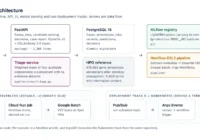
An end-to-end rare-disease variant triage platform: a Nextflow pipeline, three execution backends behind one API call, Terraform for two cloud tracks, and a phenotype-driven ranking measured against 10,178 published cases. Including the model metric that collapsed to exactly random once I removed the feature doing all the work.

Beyond the 2D Bounding Box: Why Bioimage Deep Learning Is a Completely Different Beast and How BiaPy Tames It

By | August 24, 2026

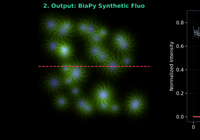
https://github.com/lynchaos/biapy-hub https://lynchaos-biapy-hub-app-hlcmfj.streamlit.app/ If you have spent your machine learning career optimizing ResNets or YOLO on ImageNet and COCO, here is an inconvenient truth: standard computer vision has spoiled you. In standard computer vision, a batch is usually an RGB triplet where . The pixels are isotropic, the spatial coordinates are Euclidean, the lighting is roughly… Read More: Beyond the 2D Bounding Box: Why Bioimage Deep Learning Is… »