The Every Company’s decision to manufacture its recombinant egg white protein OvoPro at ADM’s Clinton, Iowa facility, alongside existing capacity at Huvepharma’s Bulgarian subsidiary Biovet, illustrates a shift in how precision fermentation companies approach commercial scale-up. Rather than building proprietary plants, co-manufacturing allows capital to remain available for strain engineering and product development.
Thank you for reading this post, don't forget to subscribe!The approach relies on Komagataella phaffii, a yeast that secretes correctly folded proteins extracellularly, simplifying downstream processing. Combined with standardised feedstocks and longer shelf-stable formats, the model addresses both cost predictability and supply chain volatility, particularly relevant given recent egg price instability driven by avian influenza outbreaks.
There is a moment every bioprocess engineer knows well. Your strain behaves beautifully at 5 L. The kinetics are clean, the oxygen transfer is generous, the titre curve looks like something you would happily put on a poster. Then someone asks the question that changes the mood in the room: “So, what happens at 200,000 L?”
That question has been the quiet heartbreak of precision fermentation for a decade now. Not because the biology fails, but because the steel is expensive. A greenfield commercial fermentation plant can easily ask for north of $200 million, plus three to five years of engineering, procurement and construction before a single litre of broth exists. For a venture-backed food technology company, that is a very long time to hold your breath.
So when The Every Company announced it will manufacture its recombinant egg white protein, OvoPro, at ADM’s facility in Clinton, Iowa, shortly after expanding into Huvepharma’s capacity in Bulgaria, I read it as something warmer than a press release. It felt like the sector finally letting go of a story it had been telling itself, and choosing a gentler, more practical one instead.
Let me walk through why I think this matters, from an engineering seat rather than a headline seat.
1. Capital efficiency is a design choice, not a compromise
The old playbook was straightforward and, in hindsight, quite brave: raise an enormous round, buy stainless steel, learn to operate a plant while also learning to operate a company. Some teams managed it. Many did not, and I do not think that reflects badly on any of them. It is simply a very difficult thing to do twice at once.
The co-manufacturing route asks a different question. Instead of “how do we build capacity?”, it asks “where does capacity already exist, and how do we earn access to it?”
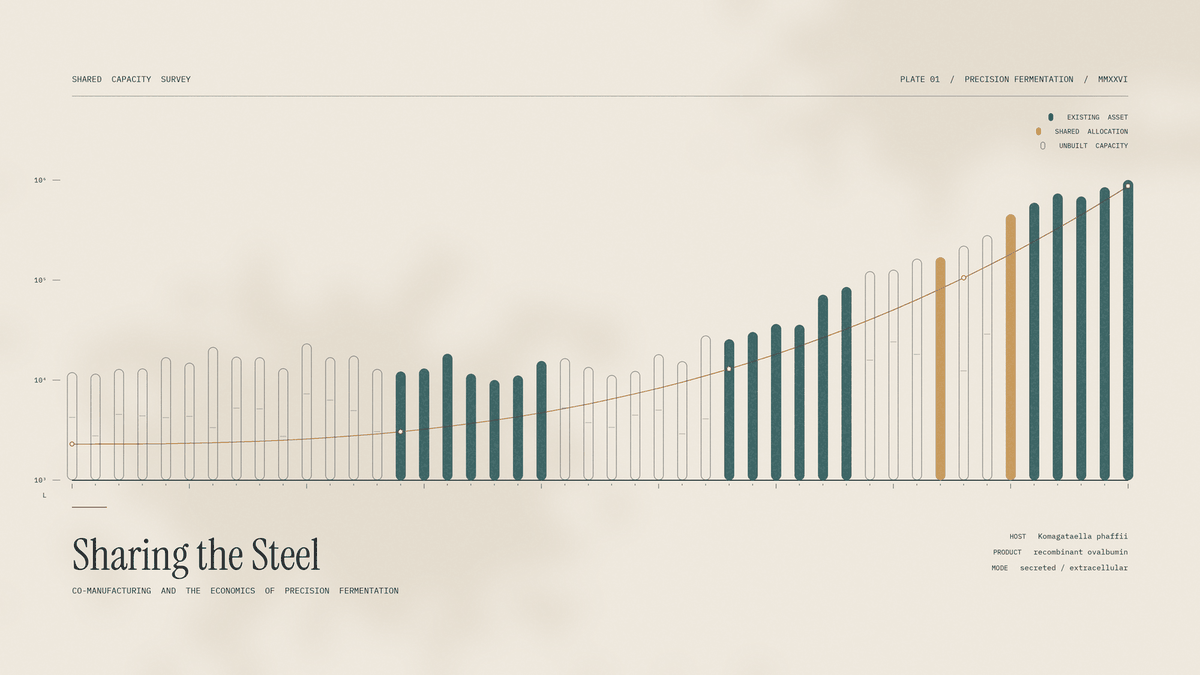
By working inside ADM’s brownfield infrastructure in Clinton and the roughly 9 million litres of fermentation capacity at Huvepharma’s subsidiary Biovet in Bulgaria, Every gets two things that are genuinely hard to buy any other way:
- Capital left in the bank. The hundreds of millions that would have gone into concrete, utilities and vessels stay available for strain engineering, formulation work and commercial development, which is where a company like Every actually creates its advantage.
- Time. Existing utility hookups, existing large vessels, existing operators who have seen a hundred campaigns go slightly wrong and know exactly which valve to check. Commercial runs arrive in months instead of years.
The timing is telling. Every announced a 550% production expansion on the back of its nationwide OvoPro rollout at Walmart and Target, which is the sort of number that makes a commercial director smile and a supply chain lead reach for a strong coffee. Demand was outrunning pilot and demonstration capacity. Securing industrial tonnage on both sides of the Atlantic is, quite simply, how you keep promises to customers.
2. The platform: why Komagataella phaffii keeps earning its place
At the centre of all this sits Komagataella phaffii, the methylotrophic yeast most of us still affectionately mis-call Pichia pastoris. It has been a workhorse for decades, and for good reasons that matter more at scale than they do at the bench.
Secretion is a gift to downstream processing. K. phaffii is excellent at secreting correctly folded, complex proteins into the extracellular medium. When your product, ovalbumin in this case, walks out of the cell on its own, you get to skip lysis entirely. No homogeniser, no cell debris burden, no cloudy soup of host cell protein and nucleic acid to fight through. Anyone who has spent a week trying to recover an intracellular product will understand why I find this quietly beautiful.
The molecule was chosen carefully. Ovalbumin makes up more than half of total egg white protein and carries most of the functional load: gelling, foaming, emulsification, binding. Delivering that one protein well means formulators can reproduce familiar egg white behaviour in baked goods, snacks and pasta without reinventing their entire process. That is a much kinder ask than “please redesign your product around our ingredient.”
Logistics quietly change too. Liquid egg lives inside a cold chain with a short shelf life and very little forgiveness. A dried, precision-fermented protein isolate can sit at ambient temperature for up to 24 months. Less refrigeration, fewer time pressures, fewer things to go wrong between the plant and the bakery.
3. Cost-in-use is where the real argument is settled
I want to be honest about something the sector sometimes glosses over. A recombinant protein does not win by matching functionality alone. It wins when a procurement team looks at two options and finds the new one easier to justify on a spreadsheet.
Egg supply is genuinely volatile. Avian influenza outbreaks and feed price swings have produced dramatic price movements across both North America and Europe in recent years. That volatility is a real operational cost, even when the average price looks reasonable.
Standardised feedstocks help here. Running on dextrose and methanol streams across both the European and US sites gives Every a predictable cost floor and a consistent process to optimise. High secretion purity feeds straight into higher downstream recovery, and recovery yield is one of the largest single levers on final $/kg for an isolated protein isolate. Every percentage point recovered is a percentage point that never needed to be fermented in the first place.
And the decisive comparison is not dry weight against dry weight. It is cost-in-use: how much of this ingredient do I need to achieve the same gel strength, the same foam stability, the same bite? When that number reaches parity with commodity egg, the conversation inside a multinational food company changes character completely. It stops being a sustainability initiative that needs a champion and becomes a supply chain risk mitigation that needs a purchase order.
What I think this signals
I have a soft spot for moments when an industry grows up a little.
The era of building bespoke, capital-heavy facilities ahead of demand is giving way to hybrid infrastructure: shared assets, brownfield conversions, and real partnerships between biotech innovators and agribusiness houses that have been running large fermenters since before most of us wrote our first line of Python.
There is something rather lovely in that. The tanks already exist. The operators already know their craft. What was missing was the willingness to share, and the humility to admit that owning the steel was never the point. Making the protein was.
As Clinton comes online and European output scales, this partnership becomes a useful proof point for the rest of us: precision fermentation can scale quickly, capital-efficiently, and at genuine commercial volume. Not by heroics, but by good engineering judgement and a sensible choice about where to put the money.
Which, if I am honest, is the version of progress I have always preferred.