


The Every Company’s decision to manufacture its recombinant egg white protein OvoPro at ADM’s Clinton, Iowa facility, alongside existing capacity at Huvepharma’s Bulgarian subsidiary Biovet, illustrates a shift in how precision fermentation companies approach commercial scale-up. Rather than building proprietary plants, co-manufacturing allows capital to remain available for strain engineering and product development.
Thank you for reading this post, don't forget to subscribe!The approach relies on Komagataella phaffii, a yeast that secretes correctly folded proteins extracellularly, simplifying downstream processing. Combined with standardised feedstocks and longer shelf-stable formats, the model addresses both cost predictability and supply chain volatility, particularly relevant given recent egg price instability driven by avian influenza outbreaks.
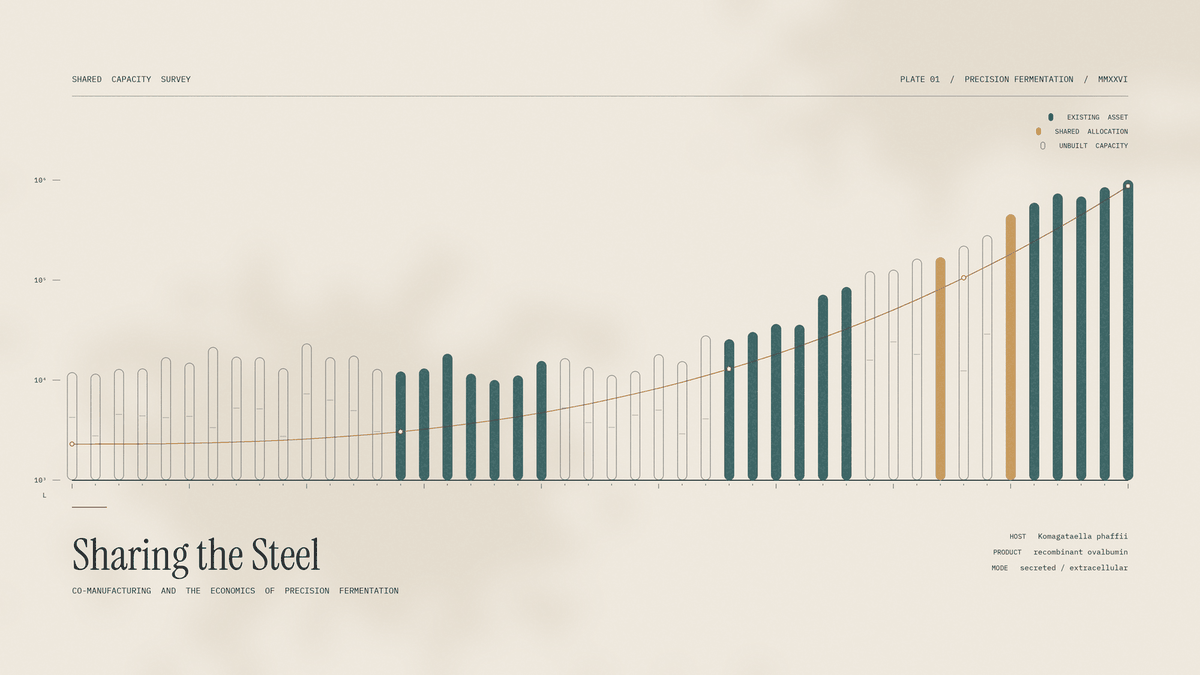
There is a moment every bioprocess engineer knows well. Your strain behaves beautifully at 5 L. The kinetics are clean, the oxygen transfer is generous, the titre curve looks like something you would happily put on a poster. Then someone asks the question that changes the mood in the room: “So, what happens at 200,000 L?”
That question has been the quiet heartbreak of precision fermentation for a decade now. Not because the biology fails, but because the steel is expensive. A greenfield commercial fermentation plant can easily ask for north of 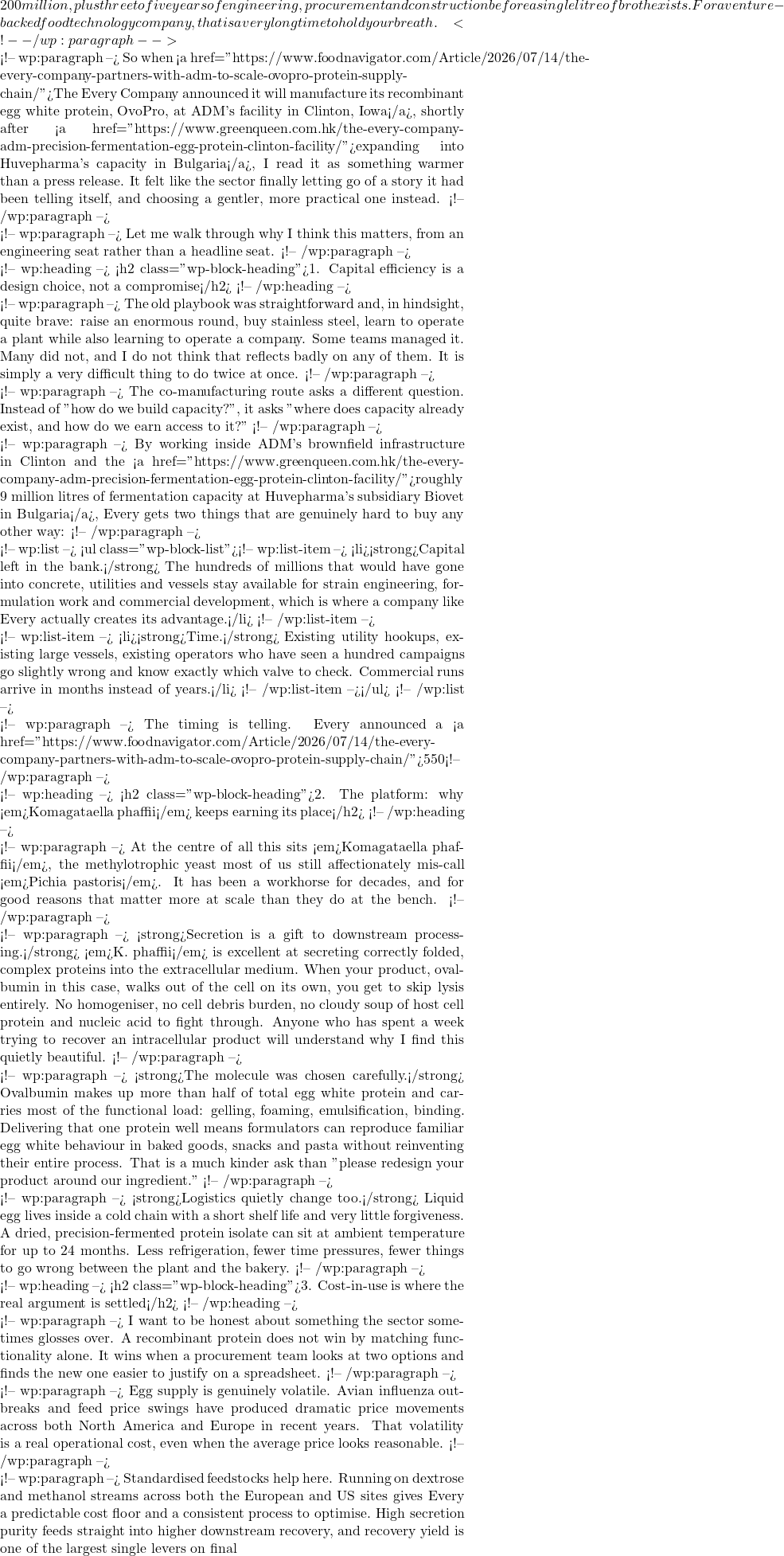 /kg for an isolated protein isolate. Every percentage point recovered is a percentage point that never needed to be fermented in the first place.
And the decisive comparison is not dry weight against dry weight. It is cost-in-use: how much of this ingredient do I need to achieve the same gel strength, the same foam stability, the same bite? When that number reaches parity with commodity egg, the conversation inside a multinational food company changes character completely. It stops being a sustainability initiative that needs a champion and becomes a supply chain risk mitigation that needs a purchase order.
What I think this signals
I have a soft spot for moments when an industry grows up a little.
The era of building bespoke, capital-heavy facilities ahead of demand is giving way to hybrid infrastructure: shared assets, brownfield conversions, and real partnerships between biotech innovators and agribusiness houses that have been running large fermenters since before most of us wrote our first line of Python.
There is something rather lovely in that. The tanks already exist. The operators already know their craft. What was missing was the willingness to share, and the humility to admit that owning the steel was never the point. Making the protein was.
As Clinton comes online and European output scales, this partnership becomes a useful proof point for the rest of us: precision fermentation can scale quickly, capital-efficiently, and at genuine commercial volume. Not by heroics, but by good engineering judgement and a sensible choice about where to put the money.
Which, if I am honest, is the version of progress I have always preferred.